How to Read Signatures and Edition Marks on Art Lithographs
A pencil signature, a fraction beneath the image and a tiny embossed seal can make art lithographs feel like puzzles. Each mark may tell you something about the artist, printer or edition, but none authenticates a work by itself. Learning to read them helps you ask better questions, recognize the difference between an original print and a reproduction and decide which details deserve to remain visible when framing.
First, establish what kind of print you have
A lithograph is a print, not an alternative to one. Lithography is one printmaking method among others, including etching, screenprinting and woodcut.
As Tate’s explanation of lithography describes, the process relies on the resistance between grease and water. The image is printed from a flat surface, traditionally limestone or a prepared metal plate.
An original lithograph is conceived as a print, sometimes through collaboration between an artist and a specialist printer. A reproduction translates an existing artwork into another printed form. Lithographic processes can also produce reproductions, so the word “lithograph” alone does not settle the distinction.
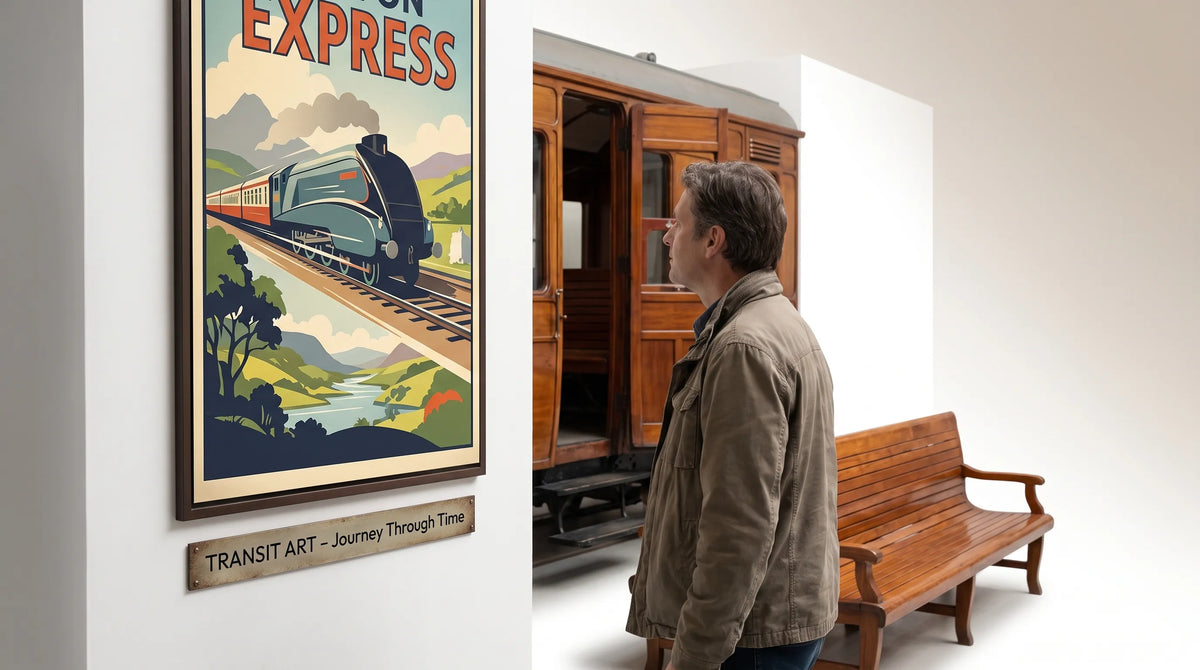
This matters with vintage transport imagery. Bicycle advertisements, railway posters and ocean-liner graphics belong to a rich printing history, but a modern poster reproducing that imagery is not necessarily an original historical lithograph.
Reading signatures on art lithographs
Start at the lower margin. An artist’s signature often appears toward the right, with an edition number toward the left. Titles, dates and workshop marks may sit between them or elsewhere on the sheet. These are conventions, not rules.
The first useful distinction is between a handwritten signature and a signature printed as part of the image.
A handwritten signature was physically added to that particular sheet. A signature “in the plate” or “in the stone” was incorporated into the printing surface and appears as part of the printed design. Both can occur on the same work.
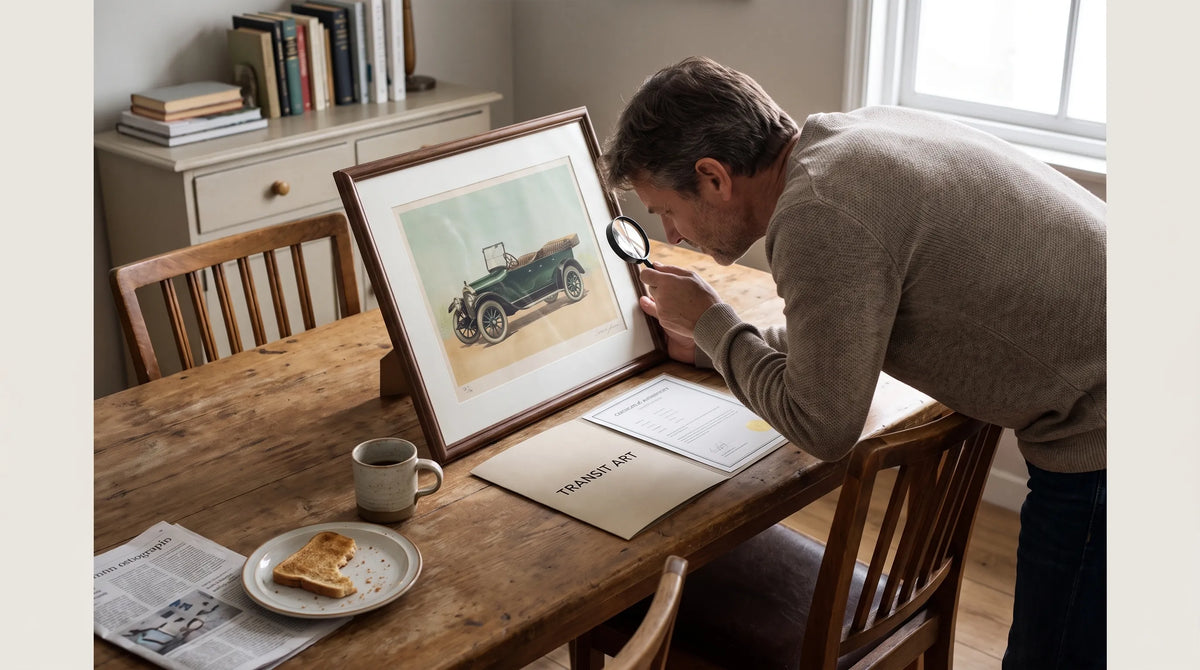
Look through a magnifier for differences between the signature and the surrounding printing. Pencil may show graphite sheen or variations in pressure. A printed signature may share the ink characteristics or dot pattern of the image. These observations are clues, not a reliable authentication test.
Never rub, erase or wet a signature to investigate it. If the work is valuable or its identity is uncertain, consult a qualified print specialist.
Does the date identify when it was printed?
Not necessarily. A date beside a signature might refer to the image’s creation, the printing or the signing. A date reproduced within a poster design may belong to the original advertisement rather than the modern sheet in front of you.
Record exactly where the date appears. Then compare it with the publisher’s description, documented edition information or the artist’s catalogue raisonné, a scholarly reference that inventories their work.
What edition numbers actually mean
When examining art lithographs, a fraction such as 24/150 generally identifies impression 24 within a numbered edition of 150.
It does not usually mean the sheet was the twenty-fourth pulled from the press. Printers may number impressions after printing and inspection, rather than in production order. A lower numerator therefore does not automatically indicate better quality or greater value.
The denominator also may not represent every authorized impression. Artist’s proofs, printer’s proofs and other designated copies can exist outside the regular numbered edition. Separate editions may use different papers, colors or formats.
| Mark | Usual reading | What it does not establish |
|---|---|---|
| 24/150 | Impression 24 in a numbered edition of 150 | Printing order or authenticity |
| Signed, without a number | A signature is present | Whether the edition was limited |
| Unnumbered and unsigned | No visible signature or edition fraction | That the print is necessarily a reproduction |
| Roman numerals | A separately designated group of impressions | Its purpose without supporting documentation |
Read the fraction alongside the full edition description, not as a standalone guarantee.
Artist’s proofs and other abbreviations
Proof terminology on art lithographs describes an impression’s designated role. It does not automatically establish superior quality or rarity.
| Abbreviation | Common meaning | Practical interpretation |
|---|---|---|
| A.P. or E.A. | Artist’s proof; épreuve d’artiste | An impression designated for the artist, outside the regular numbered edition |
| P.P. | Printer’s proof | An impression designated for the printer |
| H.C. | Hors commerce | An impression originally designated outside normal commercial sale |
| B.A.T. | Bon à tirer | The approved impression used as the printing standard |
| T.P. | Trial proof | An impression used to assess the developing image or printing |
Usage varies across artists, workshops and periods. An A.P. may look identical to the numbered edition, while a trial proof may show meaningful differences. Ask how many proofs exist and whether their status is documented before paying a premium.
Look beyond the signature: stamps, paper and provenance
An embossed mark without ink is often called a blind stamp. An inked workshop or publisher’s mark may be called a chop. Either can help identify who produced or published a print, provided the mark can be matched to reliable records.
Paper offers supporting evidence too. A watermark may help identify a paper manufacturer or stock, but it does not authenticate the image printed on it. Likewise, a deckled edge is a paper characteristic, not proof of age or artistic importance.
For art lithographs with a significant asking price, request photographs of the whole sheet, its reverse and every inscription. Ask for the printing method, sheet dimensions, publisher, edition size and any documented ownership history.
A certificate is only as useful as its issuer and supporting evidence. A vague certificate repeating the seller’s description adds little. For broader purchasing context, Transit Art’s guide to what determines the price of art prints explains how production, materials and presentation affect cost.
A practical reading of one hypothetical sheet
Imagine a print with “24/150” at lower left, a pencil signature at lower right and an embossed workshop mark below the image.
You can provisionally describe it as a signed, numbered impression with a workshop mark. You cannot yet conclude that the signature is genuine, that only 150 impressions exist across all categories or that the sheet is an original rather than a reproduction.
The next step is comparison: match the image, measurements, inscriptions and workshop mark against a reliable edition record. Keep photographs and purchase documentation together. If something conflicts, resolve it before buying rather than explaining the discrepancy away.
Interior design: make room for the margins
When displaying art lithographs, the blank paper surrounding the image can be part of the viewing experience. A signature, number or printer’s stamp gives the object a visible connection to its production.
Ask your framer to keep relevant inscriptions visible where practical. A wider mat opening may reveal the lower margin without requiring the whole sheet to be exposed. Float mounting can show sheet edges, but the mounting method should suit the paper and its condition.
For valuable works on paper, discuss conservation materials, reversible mounting and separation between the artwork and glazing. Avoid direct sunlight. UV-filtering glazing helps reduce one source of damage, but it does not make a print immune to fading.
In a modern home office, restrained frames and consistent spacing can unite different transport subjects. Match one or two visual qualities, such as typography, frame finish or image scale, rather than trying to make every picture identical.
Recommended Poster Pairings
Modern transport posters can share a room with collectible prints without being presented as equivalent objects. These two Transit Art designs connect through travel, advertising history and graphic storytelling. Their appeal does not depend on signatures or edition numbers.
Art Deco bicycles beside maritime travel
The Art Deco Elegance of Automoto Bicycles poster depicts a man and woman cycling in a vintage French advertising design. Its Art Deco character connects everyday mobility with the period’s interest in modern life and graphic design.
It makes a thoughtful choice for a home office, entryway or reading corner, particularly for someone who appreciates cycling and advertising art. When pairing it with another poster, compare the actual product images and echo a shared color through the mat or nearby furnishings.
Ocean travel as a complementary subject
The Swedish Lloyd Shipping Poster features a ship’s captain and routes linking London with Gothenburg and Stockholm. Alongside the Automoto design, it expands the story from personal transport to international travel.
Use matching frame finishes and align the frames along a shared centerline. The pair can work above a sideboard or along a hallway, where the different subjects reward a closer look. Neither needs to be described as a signed historical edition for the grouping to feel considered.

The same visual interest, on an everyday object
Transport imagery also works beyond the wall. Transit Art’s Drifting in Monaco - Mobile cover features two Ferrari F1 cars skidding through a Monaco Grand Prix curve.
The Grand Prix began in 1929, and its tight street circuit became a distinctive setting for Ferrari’s racing history during the 1950s through the 1970s. That combination of mechanical beauty, competition and place explains the subject’s appeal to motorsport enthusiasts.
The distinction remains useful when shopping: reproducing racing artwork on a mobile cover creates a design object, not a signed impression. Appreciating art lithographs can sharpen your attention to imagery and authorship without requiring every purchase to be collectible.
Frequently asked questions
Are signed lithographs valuable? Some are, but a signature alone does not establish value. Artist, authenticity, edition, condition, provenance and demand all matter. A hand-signed reproduction can also exist, so establish the printing method first.
Is an artist’s proof worth more than a numbered impression? Not automatically. Its value depends on the artist, documentation, number of proofs and whether it differs meaningfully from the regular edition. The letters A.P. alone do not justify a premium.
Can a genuine lithograph be unsigned? Yes. Some original lithographs were issued unsigned, including works intended for publications or posters. Compare the sheet with records for that specific work rather than applying a universal signature rule.
Choose with clearer expectations
The most useful way to read art lithographs is to combine their visible marks with documentation. A signature identifies a claim of authorship, an edition fraction describes a group and a workshop stamp may supply another piece of evidence.
For your home, choose the image you want to live with and understand the object you are buying. A documented collectible print and a well-chosen transport poster can both deserve a place on the wall, for different reasons.