Why Vintage Motorcycle Posters Appeal to Cafe Racer Fans
Why Vintage Motorcycle Posters Appeal to Cafe Racer Fans
For cafe racer fans, vintage motorcycle posters offer more than nostalgia. They capture the same qualities that make a stripped-back motorcycle compelling: purposeful lines, visible engineering and a sense that every component belongs. On a wall, those qualities become a way to express an interest in motorcycles without turning a living room into a showroom.
The strongest connection is not simply that both look old. Cafe racer culture and motorcycle art share an appreciation for machines with character, stories worth knowing and design that remains interesting long after fashions change.
The Cafe Racer Connection: Road Bikes With Racing Ambition
Cafe racer culture developed around British motorcycling in the 1950s and 1960s, when riders adapted road motorcycles to echo the appearance and riding position of racing machines. Low handlebars, rear-set foot controls and reduced bodywork became familiar ingredients, although individual builds varied considerably.
London’s Ace Cafe became closely associated with that scene. Its official history traces the venue back to 1938 and explains its connection with motorcyclists and rock ’n’ roll culture. The cafe provided a gathering place where the motorcycles mattered as much as the destination.
That background helps explain why a motorcycle image can feel personal. It recalls a culture built around riding, modifying machines and sharing an enthusiasm with other people.
Racing Influence Without Confusing the Categories
A cafe racer is not the same thing as a purpose-built racing motorcycle. The distinction matters when choosing artwork.
The Norton Manx, for example, was a British competition motorcycle closely associated with road racing and the Isle of Man TT. Its single-cylinder engine and racing-focused layout helped establish a visual language that cafe racer builders admired, even though a Manx itself was not a modified street bike.
For enthusiasts, vintage motorcycle posters can preserve that relationship between racing ambition and everyday motorcycle culture. A racing subject on the wall expresses the inspiration behind the build, rather than claiming that every pictured motorcycle belongs to the same category.
Why Vintage Motorcycle Posters Resonate With Enthusiasts
Mechanical Detail Becomes Part of the Composition
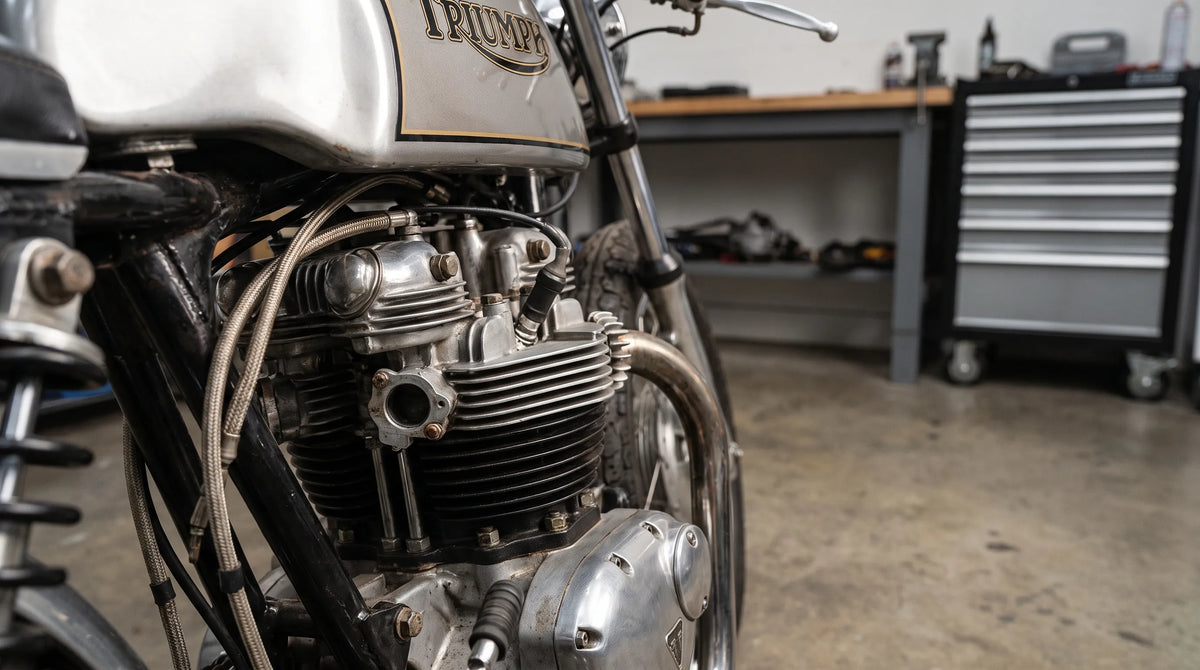
Motorcycles expose much of their structure. Wheels, engine cases, exhaust pipes and frame tubes contribute directly to the silhouette, giving an illustrator plenty to work with.
Cafe racer fans often notice these relationships immediately. The line from the tank to the seat, the space around the engine and the angle of the front fork can be as interesting as a badge or model name. A well-chosen print lets those details become the subject rather than background information.
That makes motorcycle art particularly effective in rooms with relatively simple furniture. The machine supplies visual complexity without requiring an elaborate decorative scheme around it.
The Appeal Goes Beyond a Specific Brand
Some riders collect images of a favorite manufacturer. Others respond to the broader atmosphere of workshops, race paddocks and roadside stops.
Both approaches are valid, but they create different walls. A brand-focused display feels like a personal collection, while a more varied selection can tell a story about motorcycling itself.
The lasting appeal of vintage motorcycle posters comes from this combination of recognizable machinery and emotional association. They can recall a first bike, a restoration project or the kind of riding someone hopes to do, without needing an explanatory caption.
Choose the Subject, Not Just the Retro Look
“Vintage” can describe several different things: an original period poster, a modern reproduction of historical artwork or a contemporary illustration featuring an older motorcycle. These are not interchangeable, especially for collectors concerned with provenance.
For home decorating, a contemporary print of a classic machine can be an excellent choice. What matters is understanding what you are buying and selecting an image that holds your attention beyond its aged-looking colors or typography.
Transit Art’s Two Cats, featuring a Norton Manx, offers a direct connection to British racing heritage. Harley in barn takes another approach, depicting a classic Harley-Davidson in a dusty barn setting. The first subject emphasizes competition history; the second invites an appreciation of an older machine within its surroundings.
When comparing vintage motorcycle posters, decide whether you want racing energy, mechanical detail or a quieter sense of motorcycle history. That choice is more useful than trying to make every print look equally retro.
Interior Design: Bring Motorcycle Character Into a Modern Room
Let One Print Establish the Focal Point
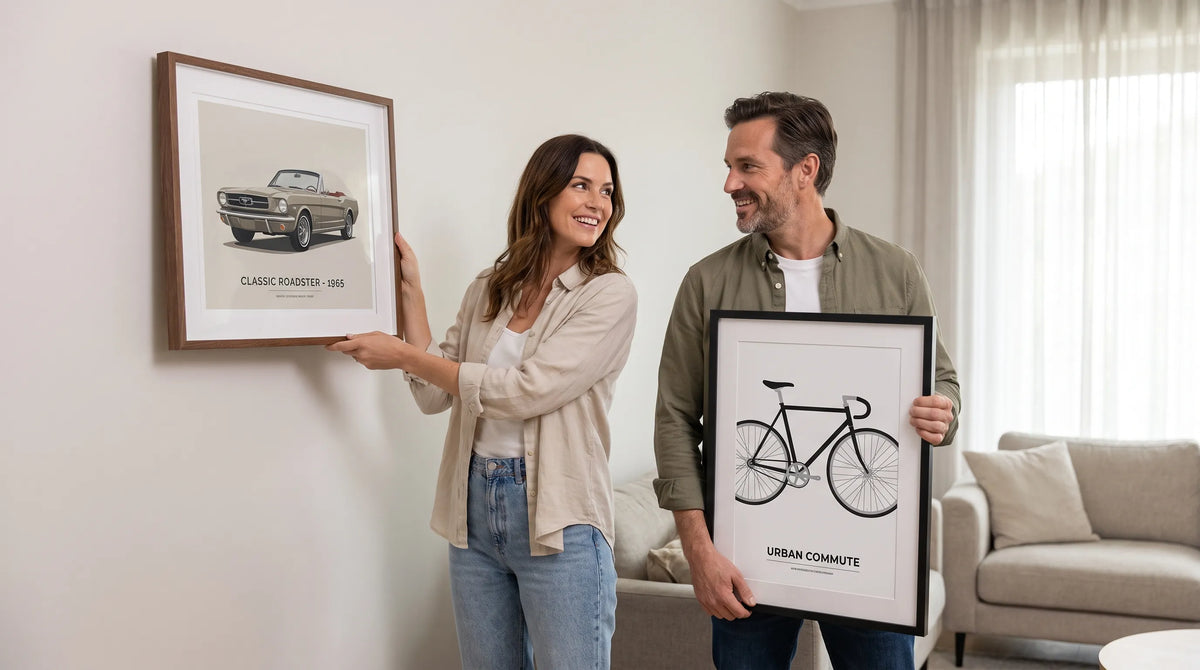
A motorcycle poster does not need themed furniture to make sense. In a home office, it can sit above a desk with a wood surface and a simple task lamp. In a living room, it can provide a personal counterpoint to neutral upholstery and restrained shelving.
Choose a print size in relation to the furniture beneath it. A small image floating above a broad sofa can look disconnected, while an oversized frame may overwhelm a narrow writing desk. Before ordering, mark the proposed frame dimensions on the wall with removable tape and assess them from the room’s usual viewing position.
Keep nearby accessories selective. One motorcycle book or a meaningful riding object can support the artwork; several unrelated signs and souvenirs may compete with it.
Match the Frame to the Room, Then Coordinate the Art
The frame provides a useful bridge between the poster and the interior. Black often works with dark metal fittings, while a natural wood frame can connect motorcycle imagery to warmer furniture. Neither choice is a rule, and the artwork should remain the deciding factor.
| Interior direction | Framing approach to consider | What keeps the display cohesive |
|---|---|---|
| Minimalist home office | Slim frame with an uncluttered presentation | One clear focal point and generous wall space |
| Warm Scandinavian-inspired room | Simple natural wood frame | Repeated wood tones and restrained accessories |
| Workshop-inspired study | Dark frame with a consistent finish | A limited selection of motorcycle-related objects |
In a shared living space, vintage motorcycle posters work best when treated as artwork first and memorabilia second. Give them the same attention to scale, spacing and framing that you would give any other print.
For a larger arrangement, Transit Art’s guide to creating a gallery wall with motorsport spirit offers a related approach to organizing transport imagery. The useful principle here is consistency: repeat a frame finish or alignment rather than making every subject identical.

Recommended Poster Pairings
A coherent pairing does not require two motorcycles from the same manufacturer. It needs a reason for the images to share a wall. These two Transit Art posters create a conversation between British competition heritage and American motorcycle culture.
Two Cats: The Racing-Heritage Anchor
Transit Art’s Two Cats Norton Manx poster is the closer match for someone whose cafe racer interest begins with British racing machinery. The Manx subject gives the arrangement a clear historical anchor without relying on generic motorcycle slogans.
Place it above a home-office desk or on the more prominent side of a two-print display. It complements Harley in barn through their shared focus on classic motorcycles, while the different subjects prevent the arrangement from feeling repetitive.
Choose matching frames to establish unity, then compare the actual artwork colors before selecting mats or nearby accessories. Shared framing is a safer starting point than assuming two motorcycle prints have matching palettes.
Harley in Barn: A Contrast in Setting and Heritage
The Harley in barn motorcycle illustration brings a different cultural reference to the pairing. Harley-Davidson’s roots reach back to Milwaukee in the early 1900s, and the marque developed a visual identity distinct from British single-cylinder racing machines.
The barn setting adds a sense of place, making this a useful companion for viewers who enjoy the atmosphere surrounding older motorcycles as much as the engineering.
Pairing these vintage motorcycle posters creates variety without abandoning the theme. The combination suits a study, reading corner or hallway where both prints can be viewed together. Keep their frame style consistent and align their centers, especially if the selected sizes differ.
Print Quality and Practical Details Worth Checking
The subject may attract you first, but the physical print determines how the artwork feels in the room. Transit Art offers gallery-quality posters printed on FSC-certified paper, with multiple sizes available. These details make it possible to choose for both the image and its intended placement.
Before ordering, check the selected product’s dimensions and material information. Plan for the outside measurements of the frame, not only the paper size, and confirm whether the presentation you want requires a mat.
A matte surface can be useful where reflected light would distract from the image, although frame glazing can still create reflections. Avoid positioning paper artwork in direct sunlight or beside sources of damp and grease.
Good presentation helps vintage motorcycle posters retain their visual impact. A carefully sized frame and a considered location usually contribute more than adding extra themed accessories around the print.
Frequently Asked Questions
Are cafe racer posters and racing motorcycle posters the same thing? No. Cafe racers are generally road motorcycles modified with racing-inspired styling and ergonomics. A poster of a competition motorcycle, such as a Norton Manx, represents part of that inspiration rather than the same type of machine.
Can Harley-Davidson artwork suit a cafe racer fan? Yes, if the person appreciates broader motorcycle history or the atmosphere of classic machines. A Harley illustration is not automatically cafe racer imagery, so choose it for its genuine connection to the recipient’s interests.
Should motorcycle prints have matching frames? Matching frames are a straightforward way to unite different motorcycles and settings. Mixed frames can also work, but they need another consistent element, such as similar proportions or a deliberately limited color palette.
Are vintage-style prints necessarily antique posters? No. They may be modern reproductions or contemporary illustrations of older subjects. Check the product description rather than assuming the word “vintage” establishes the age or provenance of the physical print.
Build a Wall Around the Motorcycles You Love
The most satisfying display starts with a real interest, not a decorating formula. Vintage motorcycle posters give cafe racer fans a way to bring racing influences, mechanical beauty and motorcycle culture into everyday surroundings.
Start with the Norton Manx if British competition history is your main connection. Add the Harley barn illustration if you want a broader story with a contrasting setting. A considered pair, comfortably scaled and simply framed, can express that enthusiasm without taking over the room.