Article: How to Hang Living Room Art Prints Above a Sofa
How to Hang Living Room Art Prints Above a Sofa
Hanging living room art prints above a sofa works best when you treat the artwork and furniture as one composition. The print needs enough presence to balance the sofa, enough clearance to avoid contact with people sitting below it and secure fixings suited to your wall.
You do not need a complicated gallery arrangement to get this right. A single well-sized aviation poster can make a stronger statement than several small prints scattered across an otherwise empty wall. Start with the sofa’s dimensions, test the layout before drilling and let the artwork’s subject guide the finishing details.
How to size living room art prints above a sofa
Measure the sofa first, then choose the artwork’s outside dimensions. Include the frame and any mat border, not just the printed image.
As a decorating starting point, aim for a composition approximately two-thirds to three-quarters of the sofa’s width. This is a proportion guideline, not a structural requirement. A narrow wall, nearby window or unusually bulky sofa may call for an adjustment.
For an 84-inch sofa, that gives you an overall artwork width of roughly 56 to 63 inches. A group of prints can fill that width just as effectively as one large frame.
| Arrangement | What to measure | Practical consideration |
|---|---|---|
| One statement print | Outside width of the frame | Leave visible wall space on both sides |
| Two prints | Both frame widths plus the gap | Similar frame sizes make alignment easier |
| Three prints | All frame widths plus both gaps | Judge the group as one composition |
| Mixed gallery wall | Width of the whole arrangement | Establish an outside boundary before hanging |
For example, three frames measuring 18 inches wide with two 3-inch gaps create a 60-inch composition. Check available print sizes before committing to a frame layout.
Set the hanging height from the sofa
For living room art prints above furniture, the relationship to the sofa matters more than a standard floor-to-center measurement.
Start by testing a gap of approximately 6 to 10 inches between the sofa’s backrest and the bottom of the frame. This is a visual starting range, not a guarantee of safe clearance. A tall backrest, reclining mechanism or deep seat may require more space.
Sit down, lean back naturally and check whether anyone could touch the frame with their head. Test the sofa in its reclined position if applicable. Measure from the fixed backrest rather than a loose cushion that changes shape or position.
Avoid raising the artwork simply to fill a tall wall. A large empty area above the frame often looks better than a print floating far away from the furniture. For a grouped arrangement, assess the gap below the lowest frame and the visual balance of the entire group.
Choose a subject that gives the room a story
Transit-inspired art can bring personal interests into a shared living space without making it feel like a collection display. Aviation imagery is especially useful when you want movement, open space and a connection to travel.
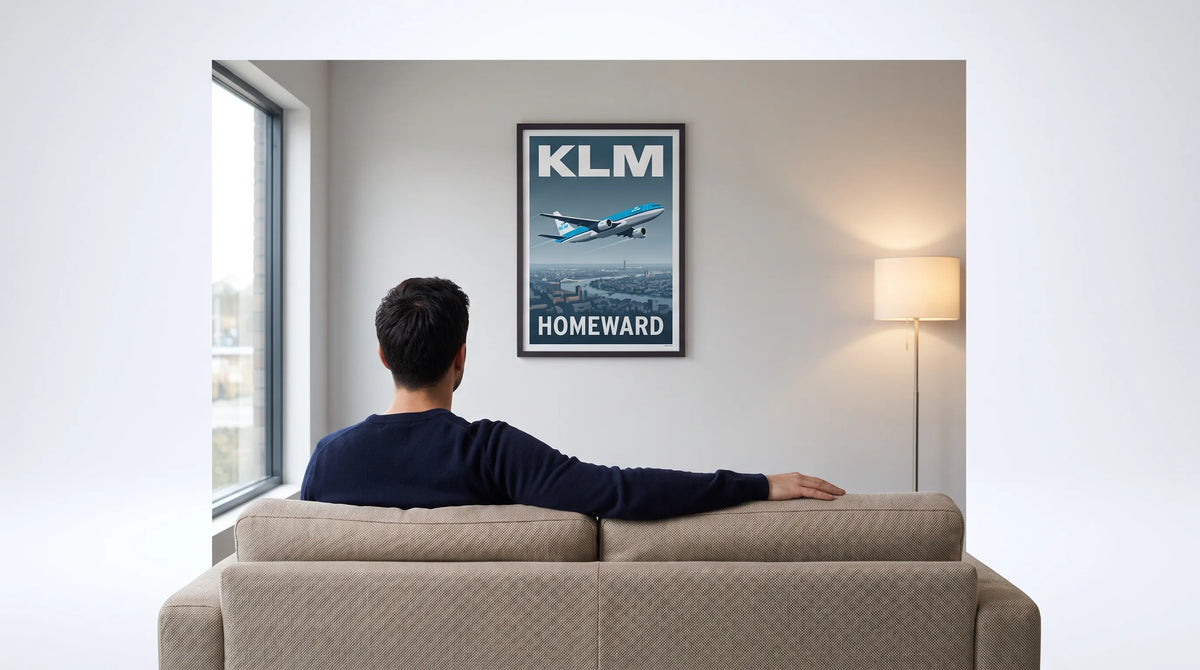
The KLM Royal Dutch Airlines “Homeward” Vintage Poster depicts a KLM aircraft against a serene twilight sky above a silhouetted landscape. That contrast gives you a practical decorating cue: balance darker details with quieter surrounding surfaces.
Why vintage aviation imagery remains appealing
KLM was founded in 1919, placing its history within the early development of commercial aviation. Vintage airline posters belong to a broader tradition of travel advertising that presented journeys as desirable experiences, not simply transportation.
The “Homeward” theme adds an emotional connection that suits a living room. Aviation enthusiasts may appreciate the aircraft, while frequent travelers and design lovers may respond to the atmosphere and sense of return.
Rather than matching every accessory to the poster, repeat one visible color in a cushion or throw. Keep neighboring objects restrained so the image remains readable from across the room.
Test the arrangement before making holes
Before installing living room art prints, make full-size paper templates of the framed pieces and try them on the wall.
Cut kraft paper to each frame’s outside dimensions. Use a wall-safe temporary attachment method, testing it first in an inconspicuous area. Some painted surfaces and wallpapers are too delicate even for removable tape.
Center the arrangement over the sofa unless the room gives you a clear reason not to. A floor lamp or side table can affect the visual balance, but centering on the entire wall often makes the art look disconnected from the seating.
View the templates from the doorway, from the opposite side of the room and while seated. For multiple frames, try gaps of 2 to 3 inches, then adjust for frame width and image density. Photograph the alternatives so you can compare them without repeatedly moving everything.
Install the frames securely
Mark the actual hanging points
The top edge of a frame is not the position of its hook. First mark where you want the top of the frame to sit, then calculate the fixing position from its hanging hardware.
For hanging wire, pull the wire taut at the intended support point and measure the vertical distance between that point and the frame’s top edge. Transfer that distance downward from your top-edge mark.
For two D-rings used directly on separate hooks, measure each ring’s position and the distance between them. Follow the frame or hardware manufacturer’s instructions. Mark the point where each ring will rest, accounting for the hook’s shape and the position of its fastener.
A measuring tape and level make this more reliable than estimating by eye. Recheck both marks before drilling.
Match the hardware to the wall and weight
Secure hanging matters especially for living room art prints positioned directly above seating.
Weigh the complete framed piece, including glazing. Choose hardware rated for that load and suitable for the actual wall construction. Drywall, plaster, brick and concrete require different fixing methods, and a package’s weight rating applies only under its stated installation conditions.
Where practical, use an appropriate fixing into a wall stud for a heavy frame. Otherwise, select anchors specifically suited to the wall and load. Do not assume ordinary screws driven into drywall alone will provide adequate support.
Check for concealed wiring and pipes before drilling. If you cannot identify the wall construction or safely support a heavy piece, use a professional installer. Adhesive hanging systems should only be used where their instructions permit the surface, weight and placement.

Check the finished installation
Once the frame is supported, check that its hardware is fully engaged and that it sits level. Small bumpers on the lower back corners can help protect the wall and reduce shifting.
Repeat the seated clearance test. Do not leave a large framed piece leaning unsecured on a narrow ledge above the sofa.
Recommended Poster Pairings
Use the KLM “Homeward” poster as the starting point, then choose companion prints from Transit Art’s current selection. The following are pairing approaches rather than named product bundles, so you can choose available designs that genuinely suit your room.
A two-print aviation pairing
Pair “Homeward” with another aviation poster that shares one visible color or a similarly spacious composition. A quieter companion will let the twilight scene remain the focal point.
Use matching frame finishes and align the top edges when the frames are the same size. This arrangement suits a compact seating area where two substantial prints feel calmer than a busy gallery wall.
A three-print travel grouping
For a wider sofa, place “Homeward” between two transport prints with compatible contrast and visual weight. The subjects do not need to be identical, but a shared travel theme and consistent framing help them belong together.
When combining living room art prints, compare the silhouettes and backgrounds as well as the subjects. Two densely detailed companions can overwhelm an airy central image. Transit Art’s guide to creating a cohesive gallery wall with framed prints explains how repeated framing and spacing can unify different designs.
Finish with frames, mats and lighting
A slim dark frame can echo the silhouetted landscape in the KLM poster, while a light wood frame may feel softer beside natural textiles. Choose the finish in relation to both the artwork and the room, rather than automatically matching every furniture leg.
A mat creates visual breathing room between the image and frame. It also increases the finished dimensions, so include it in your original measurements. If you are deciding how much border to use, this guide to choosing mat borders for paper posters offers a useful next step.
Transit Art’s posters are printed on FSC-certified paper with a gallery-quality finish. Framing still deserves care: use suitable mounting materials and keep paper artwork away from direct sunlight and damp conditions. UV-filtering glazing can reduce exposure but does not make a print immune to fading.
Check reflections from both seated and standing positions. Moving a lamp or adjusting its angle may improve visibility without changing the hanging height.
Frequently asked questions
How high should art hang above a sofa? Try a bottom-edge gap of around 6 to 10 inches above the fixed backrest, then adjust for the frame, sofa and people using it. Clearance and visual connection matter more than a single universal measurement.
How wide should living room art prints be above a sofa? A useful starting point is a combined framed width of about two-thirds to three-quarters of the sofa’s width. Count the spaces between frames as part of the total composition.
Should artwork be centered on the wall or the sofa? Usually, center it over the sofa. In an asymmetrical room, test the arrangement with paper templates and consider nearby furniture before making a small adjustment.
Can I hang a print without drilling? Sometimes, but only if the hanging system is suitable for the wall surface, framed weight and intended placement. Follow its instructions carefully, particularly above seating, and choose mechanical fixings or professional installation when needed.
Make the sofa wall feel intentional
The most useful sequence is straightforward: measure the sofa, choose the finished frame dimensions, test the arrangement and install appropriate hardware. Then refine the colors and lighting around the artwork.
A vintage aviation poster such as KLM “Homeward” adds more than a decorative subject. It gives the seating area a connection to travel and the pleasure of returning home, while thoughtful placement makes that story part of the room rather than an afterthought.