How to Dust Canvas Artwork Without Damaging the Surface
Dusting canvas artwork should remove loose particles without changing the surface. For a stable canvas print whose maker permits dry dusting, a clean, very soft brush used with almost no pressure is a sensible starting point. Water, cleaning sprays and vigorous wiping are not.
The first step, though, is identifying what you own. A printed canvas, an original oil painting and a textured acrylic painting can react differently to the same cleaning method. This guide focuses on routine dust removal from sound canvas prints, with clear stopping points for anything fragile or unfamiliar.
Identify the surface before choosing a tool
“Canvas” describes the support, not everything sitting on it. The visible surface might contain printing inks, paint, varnish or another coating. Its appearance alone cannot tell you whether it tolerates moisture or friction.
Even a product clearly identified as a canvas print, such as Transit Art’s Auto haven - canvas, needs care suited to its particular finish. The product category is not permission to use a damp cloth.
| What you have | What to establish before dusting |
|---|---|
| Printed canvas | Whether the maker recommends dry brushing or another specific method |
| Original painting on canvas | Whether the paint and any varnish are stable enough for surface contact |
| Textured or embellished canvas | Whether raised areas, attached elements or loose particles could catch on a brush |
| Artwork behind glass or acrylic | Whether you only need to clean the protective glazing |
Check the supplier’s care instructions first. If those instructions are missing, ask rather than assuming that “protective coating” means washable.
The practical rule is simple: identify the surface of your canvas artwork before choosing a tool. For an original, valuable or damaged painting, the American Institute for Conservation is a useful starting point for finding professional conservation help.
How to dust canvas artwork safely
Use the following method only for an intact canvas print whose supplier permits gentle dry brushing. It is not a universal cleaning procedure for painted originals.
1. Inspect without touching
Look across the surface in good, indirect light. Check for lifting edges, cracks, flaking, loose material, sticky patches or areas that appear powdery. Also check whether the canvas has become slack or detached from its stretcher.
If anything looks unstable, stop. A brush can carry away loose ink or paint along with dust. Suspected mold, insect deposits and ingrained grime also need a different response from ordinary household dusting.
2. Set up a stable working position
Clear the surrounding area and wash and dry your hands. Remove rings or bracelets that could scrape the image or catch an edge.
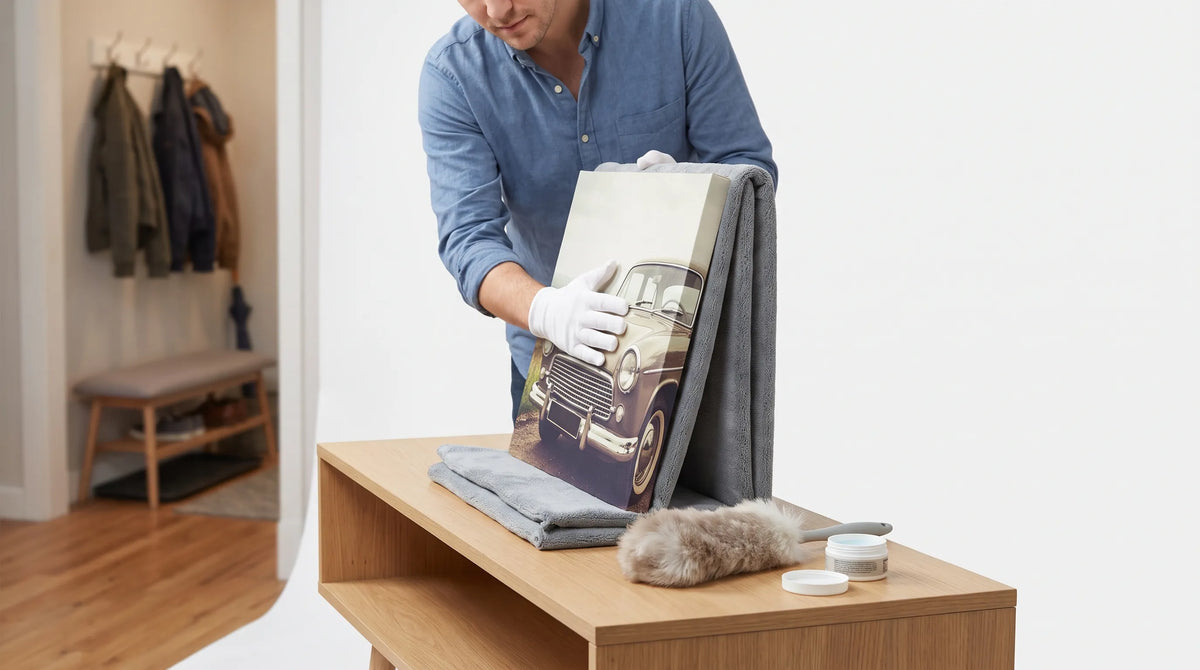
If you can safely take the print down, place it face-up on a clean, stable table with smooth padding beneath its wooden stretcher. Keep canvas artwork supported by its frame rather than pressing on the fabric. Do not attempt to handle a large or heavy piece alone.
Avoid resting tools on the image, even briefly.
3. Choose a clean, very soft brush
A dedicated, very soft artist’s brush is easier to control than a household duster. Its bristles should be clean, dry and free of paint residue. Keep the metal ferrule well away from the surface.
Avoid stiff bristles, feather dusters and anything that sheds or snags. A microfiber cloth may be appropriate for some approved finishes, but it is not a universal substitute: wiping can catch on texture or drag grit across the image.
4. Lift loose dust with minimal contact
Hold the brush at a shallow angle and make light, controlled passes toward an outer edge. Let the bristle tips barely contact the surface. Do not scrub, work in circles or push the brush into the weave.
Check the brush as you work. If you notice color transfer, fragments, snagging or any change in sheen, stop immediately.
Dusting canvas artwork should remove loose surface particles, not change a mark or stain. If a spot remains after a gentle pass, leave it alone rather than increasing pressure.
5. Clean the surrounding frame separately
For a plain, stable frame, use a separate soft brush or a dry cloth appropriate to its finish. Avoid transferring frame dirt onto the image. Ornate, gilded or flaking frames may require specialist care.
Do not insert a vacuum nozzle behind the canvas or try to extract debris trapped between the fabric and stretcher. Pressure and accidental contact can damage the work. Leave embedded material for someone equipped to remove it safely.
What not to use on the image surface
Keep glass cleaner, furniture polish, alcohol, disinfectant wipes and household detergents away from the print. They can affect inks or coatings, leave residue or alter the sheen. Do not apply varnish or a protective spray as a home maintenance treatment.
Water is not a neutral solution either. It can affect the image layer, leave tide marks or change canvas tension. Unless the maker explicitly supplies a wet-cleaning method for that exact product, keep routine care dry.
Canned air, hair dryers and direct vacuum suction are poor substitutes for controlled brushing. They introduce pressure, heat or other avoidable risks. Bread, erasers and cleaning sponges are also unsuitable general-purpose tools for a printed image.
If dust will not lift easily, stop. Persistent grime needs an assessment, not a stronger cleaner.

Interior design choices that make care easier
Good placement reduces exposure and makes maintenance less awkward. Display canvas artwork away from cooking grease, fireplaces, frequently opened exterior doors and places where people regularly brush against it. Avoid damp rooms and positions immediately beside heating or cooling outlets.
Direct sunlight can contribute to fading and uneven aging. Choose a wall with indirect light rather than treating a bright window-facing position as harmless because the picture looks vivid today.
For a living room, leave enough clearance above furniture to reach the frame without leaning heavily over the sofa. On a gallery wall, allow space between pieces so you can handle one without knocking its neighbors. Keep fragile objects off the console beneath your artwork before cleaning.
Visually, a single automotive canvas can anchor a restrained room, while smaller framed posters add historical detail nearby. Repeating a frame finish or one accent color keeps the arrangement coherent. Transit Art’s guide to pairing canvas home decor with modern furniture explores that decorating approach in more detail.
Recommended Poster Pairings
A mixed arrangement of canvas artwork and framed posters can connect a love of transport with a room’s existing palette. These two Transit Art posters offer complementary views of early motoring culture, though their care requirements should not be confused with those of exposed canvas.
Norton’s monochrome precision
The 1930 Norton Motorcycle “Unapproachable” Advertisement Poster centers on a classic black-and-white motorcycle image and a confident advertising slogan.
Founded in Birmingham in 1898, Norton developed a reputation closely associated with motorcycle engineering and competition. The poster’s emphasis on the machine’s silhouette and mechanical detail makes it particularly appealing to riders, vintage advertising collectors and enthusiasts who appreciate functional design.
Its monochrome treatment provides a calm counterpart to more colorful automotive art. Consider it beside a canvas in a home office with black metal shelving, warm wood furniture or restrained upholstery.
Maserati’s theatrical racing energy
The 1929 Circuito Automobilistico di Cremona Maserati Poster takes a more dramatic approach, showing a red number 36 Maserati with a fiery phoenix behind it.
Maserati was founded in Bologna in 1914 and introduced its first car bearing the marque’s name in 1926. This poster belongs to that early racing period, when promotional art turned mechanical speed into a visual spectacle.
Paired with the Norton design, its red car supplies a focused color accent while the shared interwar subject matter holds the grouping together. The combination suits a study or reading corner, especially when matching frames bring consistency to the contrasting compositions.
Both products are listed as posters. If displayed behind glass or acrylic, maintain the glazing according to its manufacturer’s instructions rather than opening the frame to dust the print.
Frequently asked questions
How often should I dust canvas artwork? Inspect it periodically, perhaps during your monthly room-cleaning routine, but only dust when needed. Placement and household conditions matter more than a fixed calendar. Unnecessary handling adds avoidable risk.
Can I use a damp microfiber cloth? Only if the manufacturer explicitly recommends it for that exact canvas finish. A method suitable for one coated print may damage another. Without clear instructions, do not introduce moisture.
What if dust is caught in the canvas texture? Do not push the brush deeper into the weave or scrub repeatedly. If minimal brushing does not release it, ask the supplier or a conservator for advice.
Can I remove fingerprints or greasy marks at home? Treat these as stains rather than dust. Oils and embedded dirt may require surface-specific treatment. Avoid spot-cleaning experiments, including tests on an inconspicuous corner, without professional or manufacturer guidance.
Should I dust the back as well? Do not disturb backing boards, labels or attachments. Never press into the reverse of the canvas or use direct suction. If the back has substantial debris, insect activity or signs of damp, seek advice before handling it further.
Keep the image, not the cleaning, in focus
The best routine for canvas artwork is deliberately modest: identify the finish, inspect its condition and remove only loose dust using an approved method. Thoughtful placement does the rest. Whether your wall celebrates vintage motorcycles, Italian racing or automotive scenes, gentle care helps preserve the details that made you choose the artwork in the first place.