
Article: 5 Ways to Balance Modern Vintage Decor Without Clutter
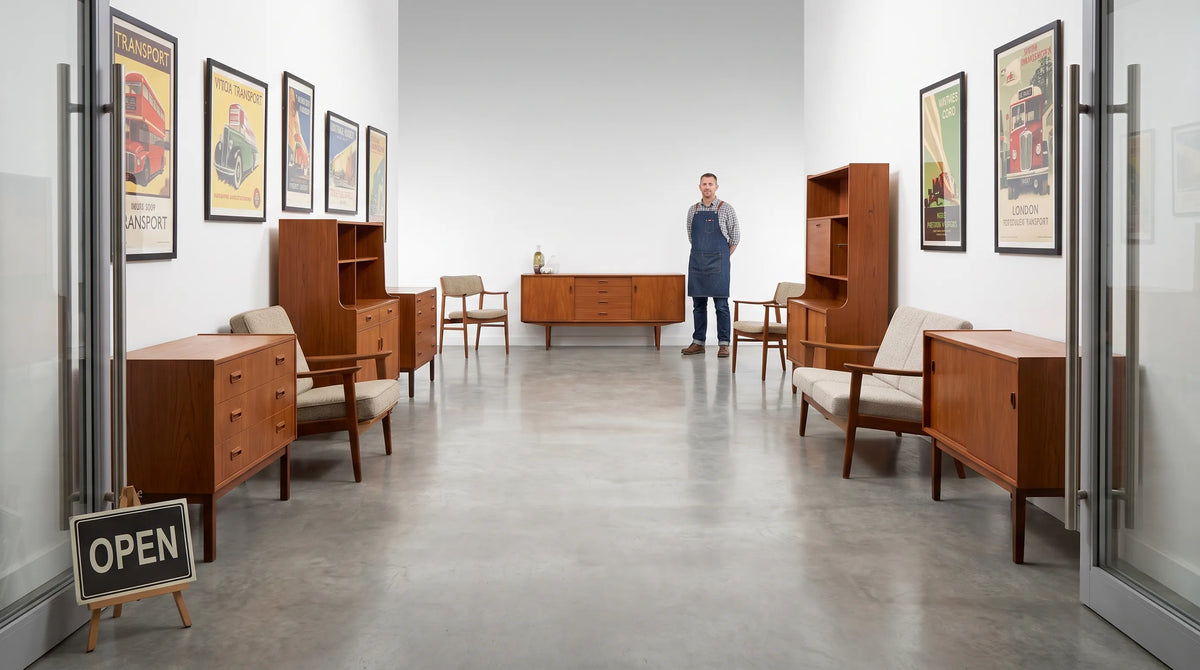
5 Ways to Balance Modern Vintage Decor Without Clutter
5 Ways to Balance Modern Vintage Decor Without Clutter
The appeal of modern vintage decor is the contrast: clean-lined furniture gives a room breathing space, while older forms and nostalgic artwork bring character. The difficulty comes when every interesting find competes for attention. A racing poster, a weathered cabinet and a shelf of collectibles can each be appealing, yet together they may leave the room feeling crowded.
You do not need to choose between personality and simplicity. These five approaches help you display the pieces you love, connect different eras and keep your home comfortable to use.
1. Give modern vintage decor a clear focal point
Start by deciding what you want someone to notice first. It might be a vintage sideboard, a transport-inspired print above the sofa or an inherited reading chair. Choose one leading feature within each area of the room, then make the surrounding elements quieter.
A focal point does not have to be the oldest or most expensive object. It should be the piece with the strongest visual presence or personal meaning. For a car enthusiast, an automotive print may deserve that role more than a decorative mirror chosen simply to fill a wall.
Separate character from visual competition
In modern vintage decor, balance comes from giving distinctive pieces enough space to be understood. A richly grained cabinet already contributes texture, color and history. Placing several small frames, patterned ceramics and a bright lamp on top can obscure what made it attractive in the first place.
Try the cabinet with one framed artwork above it and a practical lamp on its surface. Leave the remaining space available for daily use rather than filling it automatically.
Take a photograph from the room’s entrance. A photograph makes competing shapes easier to spot. If your eye keeps jumping between several equally strong objects, remove or relocate one before buying anything else.
2. Connect different eras through color and finish
Objects do not need to share a decade to belong together. They need a visible relationship. Repeated colors, compatible finishes and similar proportions can connect a contemporary sofa with a retro print more effectively than a room full of matching vintage furniture.
Begin with the largest existing surfaces: walls, flooring and upholstery. Then identify one or two colors in the artwork that you can repeat elsewhere. A small accent in a cushion or lampshade is often enough; matching every accessory makes the room feel overly coordinated.
| Existing room feature | Vintage element to consider | A simple connecting detail |
|---|---|---|
| Light walls and pale wood | A transport print with warm paper tones | A natural wood frame |
| Dark furniture and metal accents | Automotive artwork with strong contrast | A restrained black frame |
| Soft gray upholstery | A print containing a muted accent color | One textile that repeats that color |
These are starting points, not rules. Check the actual artwork before choosing paint or textiles, since different prints can have very different palettes.
A limited palette helps modern vintage decor feel intentional without making every object look alike. You can keep the patina of an older piece while giving it a modern setting through a simple frame, plain upholstery or an uncluttered wall.
3. Edit the wall before adding more objects
Wall art can express an interest without occupying a tabletop, but a gallery wall can still create visual clutter. The problem is usually not the number of pictures alone. It is the combination of inconsistent spacing, unrelated subjects and several competing frame styles.
Choose a clear organizing idea before you hang anything. That could be automotive engineering, the experience of travel or a shared color palette. Start with a pair or a small group, then leave the surrounding wall clear.
For modern vintage decor, a smaller arrangement with a strong connection often feels more considered than a large collection assembled merely to cover empty space.
Recommended Poster Pairings
A transport-themed pairing worth considering is the 1950 BMW racing poster featured in Transit Art’s breakfast-nook guide alongside the vintage KLM aviation poster discussed in its sofa-hanging guide. The subjects connect through movement and transport history without repeating the same vehicle type.
The BMW racing subject brings competition and mechanical energy into the arrangement. It suits a home office or reading corner where an enthusiast wants a personal reference without turning the entire room into a themed display. The KLM aviation subject broadens that story toward travel, making the pairing appropriate for a shared living room too.
Compare the actual prints’ colors and proportions before choosing sizes. Similar frames can unify different compositions, while aligned edges and consistent spacing help the pair read as one arrangement. Test the layout with paper templates before making holes.
This approach keeps modern vintage decor focused on a relationship between artworks, rather than on accumulating more pictures. If the pair already fills the available wall comfortably, a third print is optional, not necessary.
4. Let useful objects carry personal history
Not every expression of your interests needs a permanent place on a shelf. A useful object can carry the same emotional connection as a collectible while avoiding another item that exists only to be displayed.
For automotive enthusiasts, this is especially helpful. Model cars, books and memorabilia can quickly occupy desks and sideboards. Choosing a few everyday items with meaningful imagery lets you enjoy the subject without giving every object its own display area.
A classic Mercedes in an everyday format
Transit Art’s Mercedes 300 SL at Workshop - Mobile cover features the classic car at a service station. That setting offers a different perspective from a glamorous showroom image: it connects the vehicle to the practical world of maintenance and care.
The road-going Mercedes-Benz 300 SL coupe debuted in 1954, following the marque’s 1952 racing sports car. Its roof-hinged gullwing doors accommodated the high sides of its tubular spaceframe chassis, while its fuel-injected inline-six engine contributed to its performance reputation. The combination of engineering and distinctive proportions explains its lasting appeal to collectors and design-minded enthusiasts.
On a phone cover, that heritage becomes part of an object already used every day. It is also a thoughtful direction for a gift buyer who knows someone loves classic Mercedes cars but does not know how much wall space they have. Confirm compatibility with the recipient’s phone before ordering.
The lesson for modern vintage decor is broader than one product: let some personal references live on useful objects, so shelves and walls do not have to carry the whole story.

5. Create an editing routine, not a permanently finished room
Clutter often arrives gradually. A new print joins an old arrangement, a gift takes up residence on the sideboard and a temporary stack of books becomes part of the decor. Keeping a balanced room requires occasional editing rather than one perfect shopping trip.
Review one surface at a time. Remove everything, return the objects needed for daily use and then add back the decorative pieces that still matter to you. This makes it easier to distinguish a deliberate display from items that have simply stayed in place.
Keep circulation and surfaces usable
A room should work before it photographs well. Check whether you can set down a drink, open cabinet doors and move between furniture without navigating around decorative objects. If an arrangement interferes with those tasks, reduce it or move it elsewhere.
Rotating a collection can also help. Display a small selection and store the rest safely, then change the selection when you want a different mood. Paper prints should be protected from bending, moisture and prolonged direct sunlight whether they are displayed or stored.
The most sustainable approach to modern vintage decor is keeping what you enjoy and giving it an appropriate place. Empty space is not a missing purchase; it helps the chosen objects remain visible and the room remain useful.
Frequently Asked Questions
Does vintage-style artwork have to be an original antique? No. A newly made print can introduce historical subject matter or a retro aesthetic without being an antique. Distinguish the age of the subject from the age of the physical object, particularly when comparing condition, price and care requirements.
Can I mix automotive and aviation posters? Yes, provided there is a clear connection. Transport history can supply the theme, while compatible colors, frames or proportions give the arrangement visual cohesion. Compare the actual artwork rather than assuming that all vintage posters share a palette.
How do I know when a room has too many vintage pieces? Look for competing focal points, crowded surfaces and objects that obstruct everyday use. Modern vintage decor feels balanced when you can appreciate individual pieces without needing to move several others out of the way.
Should all my frames match? They do not have to. Matching frames are a straightforward way to unify different subjects, but a small variation can work when another detail, such as color or alignment, remains consistent.
Make space for the pieces that matter
A balanced room does not need fewer interests. It needs clearer choices about how to display them. Give one piece the lead, connect eras through color and let useful accessories carry some of the personal detail.
When exploring Transit Art’s transport-inspired artwork and accessories, start with a subject that means something to you and a specific place for it. That keeps the next addition purposeful rather than simply adding more.

