Artikel: Classic Prints Inspired by the Elegance of Amilcar Cars

Classic Prints Inspired by the Elegance of Amilcar Cars
Classic Prints Inspired by the Elegance of Amilcar Cars
The appeal of classic prints often begins with the character of their subject. Amilcar’s compact French sports cars offer something distinctive: long bonnets, purposeful proportions and an elegance rooted in lightweight engineering rather than size or extravagance. Their visual identity makes a compelling starting point for automotive art that feels equally at home in a study or a thoughtfully furnished living room.
An Amilcar poster can also tell a broader story about travel and design. Paired carefully with vintage aviation artwork, it connects the pleasures of the open road with the optimism of flight. The key is to let the car’s history guide the arrangement without turning the room into a themed display.
The French Sporting Story Behind Amilcar
Amilcar was founded in France in 1921 by Joseph Lamy and Émile Akar. The marque emerged when small, relatively lightweight vehicles offered an alternative to larger and more expensive automobiles. Its early cars belonged to the world of cyclecars and compact sporting machines, where modest dimensions and mechanical simplicity were central to their appeal.
That background matters when interpreting Amilcar artwork. These were not imposing luxury cars designed primarily to announce wealth. Their attraction came from agility, accessible sporting ambition and a close connection between driver and machine.
For collectors choosing classic prints, this gives Amilcar a different emotional register from a grand touring limousine or a modern supercar. The subject suggests enthusiasm and resourcefulness, with enough historical depth to reward a closer look.
From the CGS to the Lower-Slung CGSS
The CGS, introduced in 1924, helped establish Amilcar’s sporting reputation. Its approximately 1.1-liter four-cylinder engine powered a light car whose appeal depended on the relationship between weight and performance, not a headline-grabbing engine capacity.
The CGSS followed in 1926 with a lower-slung configuration that reinforced the marque’s athletic appearance. On many surviving sporting Amilcars, the long bonnet, open cockpit and separate fenders create a profile that remains immediately recognizable.
Amilcar also developed more specialized competition machinery, including the six-cylinder C6. That racing history should not be confused with the specifications of its four-cylinder road cars, but it helps explain why the name carries significance beyond attractive bodywork.
For an enthusiast, an Amilcar image can therefore represent a whole approach to motoring: small-scale engineering, sporting experimentation and the pleasure of driving something mechanically direct.
Why classic prints suit Amilcar’s sporting elegance
The attraction is not limited to people who know every model designation. An automotive enthusiast may appreciate the marque’s history, while a design-conscious homeowner may respond to its proportions and the visual language of vintage advertising.
Transit Art’s Le Grand Sport Amilcar Vintage Poster provides a natural focus for that interest. Its title foregrounds the sporting identity of the marque, making it a starting point for a wall arrangement built around French motoring heritage.
Rather than treating the poster as a technical illustration of a particular model, approach it as automotive advertising art. The car supplies the historical interest, while the composition and lettering determine how the print interacts with your room.
This distinction is especially useful for gift buyers. Someone who enjoys unusual European cars may value the Amilcar connection, while a recipient interested in graphic design may appreciate a subject that feels less familiar than the usual automotive icons.
Bringing Amilcar Art Into a Modern Interior
Give the Main Print Enough Space
A visually distinctive poster usually benefits from a clear area around it. Above a console, beside a reading chair or on the wall behind a desk, it can establish a focal point without requiring a collection of matching objects underneath.
When decorating with classic prints, choose the wall before choosing the size. Measure the available area and mark the proposed dimensions with removable painter’s tape. This makes it easier to judge whether the artwork will look intentional rather than undersized.
In a living room, relate the print to the furniture beneath it. In a study, consider the view from the doorway as well as the view from the desk. A pleasing arrangement should work from the positions where the room is actually used.
Let the Artwork Set the Color Direction
Start with the colors visible in the product image, then repeat one restrained accent elsewhere in the room. A cushion, a book spine or a ceramic object is enough. Matching every accessory to the artwork usually makes the setting feel overly coordinated.
A neutral Scandinavian-style interior can accommodate vintage automotive advertising without losing its calm character. Pale walls and simple furniture give the print space to stand out. In a warmer room, wood furniture and woven textiles can soften the mechanical subject matter.
Frame choice should support the composition. A narrow black frame can provide definition, while a wood frame may connect the artwork to nearby furniture. Neither is automatically correct; compare the frame against both the print and the wall color.
Keep a Gallery Wall Visually Connected
If you want several posters, establish one shared feature before arranging them. That might be the frame finish, the outer dimensions or a consistent amount of space between pieces.
The subjects do not need to be identical. A car and an aircraft can belong together when both communicate travel, movement and period advertising design. What matters is that the arrangement reads as a deliberate selection rather than a collection of unrelated favorites.
Place the Amilcar artwork where it can retain its identity. If neighboring posters have stronger contrast or larger lettering, avoid allowing them to dominate the grouping.

Paper, Frames and the Finished Look
The subject draws you in, but the physical presentation determines how the artwork feels in the room. Transit Art describes its poster offering as using gallery-quality materials and FSC-certified paper. Check the individual product listing for available sizes and the details applicable to the print you select.
Paper certification and visual finish answer different questions. FSC certification concerns responsible sourcing standards, while the appearance of a finished display also depends on printing, framing and lighting.
For a closer look at presentation choices, Transit Art’s guide to creating a gallery-quality look with prints on paper offers related decorating ideas.
Avoid placing paper artwork in direct sunlight or against a persistently damp wall. Position the frame where reflections will not obscure the image during the times you most often use the room.
Recommended Poster Pairings
A successful pairing should add another chapter to the Amilcar story, not merely fill an empty space. These two aviation posters offer complementary directions for classic prints centered on travel and transport culture. They need not date from precisely the same period to create a coherent display.
Air France: A Shared French Travel Theme
The Air France 'Vers Des Ciels Nouveaux' Vintage Poster (Percival) connects naturally with Amilcar through French transport heritage. Its invitation, “Vers Des Ciels Nouveaux,” means “Towards New Skies,” extending the wall’s subject from sporting motoring to the possibilities of air travel.
Percival’s illustrated aviation artwork introduces another expression of movement. The connection is cultural rather than mechanical: two different forms of transport presented through the persuasive language of vintage advertising.
This pairing suits a home office, hallway or reading area where the artwork can encourage curiosity about travel history. Use coordinated frames to unite the pieces, then compare their actual colors before introducing additional accents. Side by side, the posters can create a balanced conversation between road and sky without requiring identical compositions.
KLM “Homeward”: A Quieter Aviation Companion
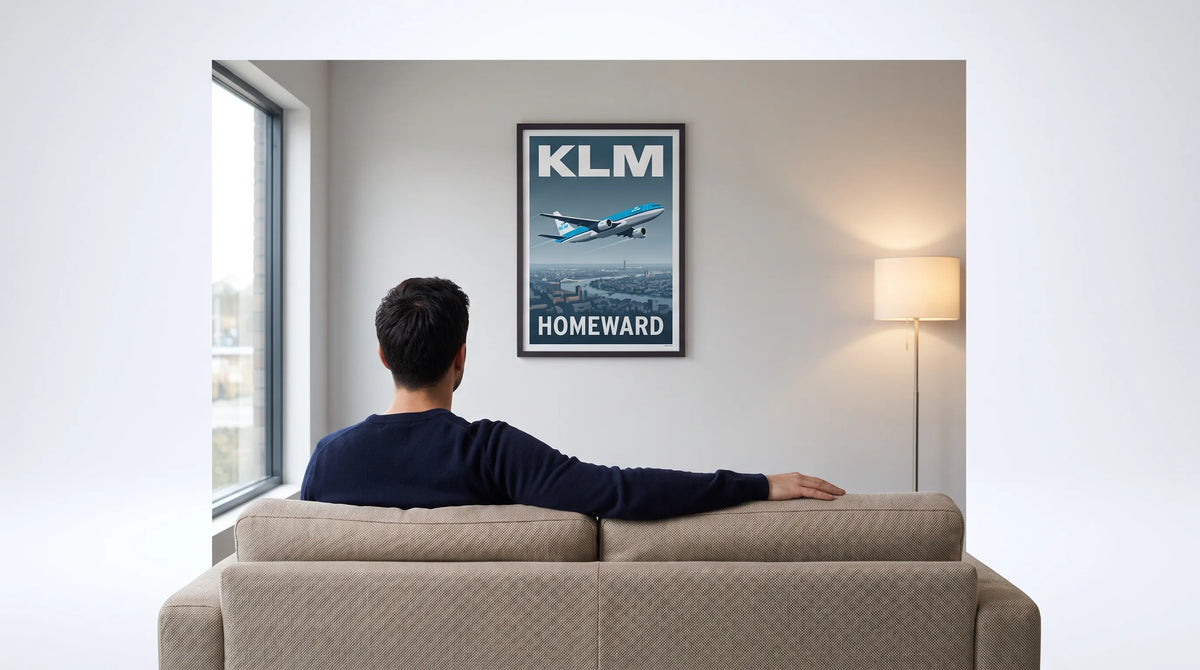
The KLM Royal Dutch Airlines "Homeward" Vintage Poster offers a different mood. Its aircraft appears against a serene twilight sky above a silhouetted landscape, introducing an atmosphere of distance and return.
For readers who prefer classic prints with a less overtly sporting atmosphere, this pairing gives the display a gentler narrative. Amilcar contributes the pleasure of the journey, while “Homeward” brings in the emotional pull of arriving somewhere familiar.
Consider this combination for a living room or landing rather than a busy collection wall. Give each piece enough room to be read independently. If you use all three posters, keep the spacing consistent and judge their visual weight before deciding which belongs in the center. The calmest image may work best at the edge of the grouping.
Frequently Asked Questions
What made Amilcar cars distinctive? Amilcar became known for compact, lightweight sporting cars during the 1920s. Models such as the CGS and CGSS combined modest engine capacity with purposeful proportions and an engaging sporting identity.
Can automotive posters work in a minimalist living room? Yes. One well-positioned print can introduce personality without adding physical clutter. Keep the surrounding furniture simple and use the artwork, rather than extra automotive accessories, as the main statement.
Does “vintage poster” always mean an original historical sheet? No. The term can describe a historical design, a reproduction or a vintage-inspired aesthetic. Check the product description to understand what is being offered rather than assuming that the wording indicates an original collectible.
Should car and aviation posters use matching frames? Matching frames are an easy way to connect different subjects, but they are not essential. A shared finish, consistent spacing or aligned outer edges can provide enough structure for the arrangement to feel cohesive.
Build a Display Around What Interests You
The most satisfying classic prints do more than coordinate with a sofa. They give you something worth looking at and talking about. Amilcar brings a distinctive chapter of French automotive history into that daily experience, with a sporting elegance that works beyond a dedicated car enthusiast’s room.
Start with the Amilcar poster as your focal point, then add an aviation companion only if it strengthens the story you want to tell. Transit Art’s vintage and retro poster collection offers a broader setting for exploring those connections. A small, considered selection will usually feel more personal than a wall filled all at once.